Table of Contents
- The 10 Best Materials for Packing Antique Furniture
- 1. Moving Blankets
- 2. Bubble Wrap
- 3. Packing Paper
- 4. Foam Sheets and Foam Rubber
- 5. Cardboard Boxes and Cardboard Sheets
- 6. Plastic Wrap
- 7. Packing Tape
- What Else Belongs in Your Kit
- How to Pack Antique Furniture for Moving
- How to Protect Antique Furniture During a Move
- Custom Crating for Antique Furniture
- Frequently Asked Questions
Last Updated: October 5, 2026
The 10 Best Materials for Packing Antique Furniture
Packing antique furniture means wrapping, cushioning, and securing aged wood, veneer, upholstery, and finish so a piece survives a move without a new scratch, chip, or crack. At WePackYou, we pack antique furniture for collectors, galleries, and families across the DC Metro area. Get the materials right and most damage never happens; get them wrong and one roll of the wrong tape can lift a hundred-year-old finish.
How the Materials Were Ranked
We ranked these materials on protection level, finish safety, cost, and reusability. Finish safety carries the most weight: antique wood, shellac, lacquer, and gilding react badly to certain plastics and adhesives, so a material that cushions well but damages the surface ranks lower.
Never let standard masking tape, duct tape, or packing tape touch bare antique wood. The adhesive bonds to shellac and lacquer, and removing it can pull the finish off in patches. Tape goes on the wrapping, never on the piece.
Quick Comparison of the 10 Materials
| Material | Protects Against | Best For | Reusable |
|---|---|---|---|
| Moving blankets | Impact, scratches | Large furniture, tabletops | Yes |
| Bubble wrap | Impact, vibration | Carved details, fragile parts | Sometimes |
| Packing paper | Scratches, dust | Direct-contact wrapping | No |
| Foam sheets | Impact, edges | Corners, thin panels | Yes |
| Cardboard boxes and sheets | Impact, punctures | Structure, glass, panels | Yes |
| Plastic wrap | Dust, moisture, shifting | Holding covers in place | No |
| Packing tape | Opening, shifting | Sealing boxes and wraps | No |
1. Moving Blankets
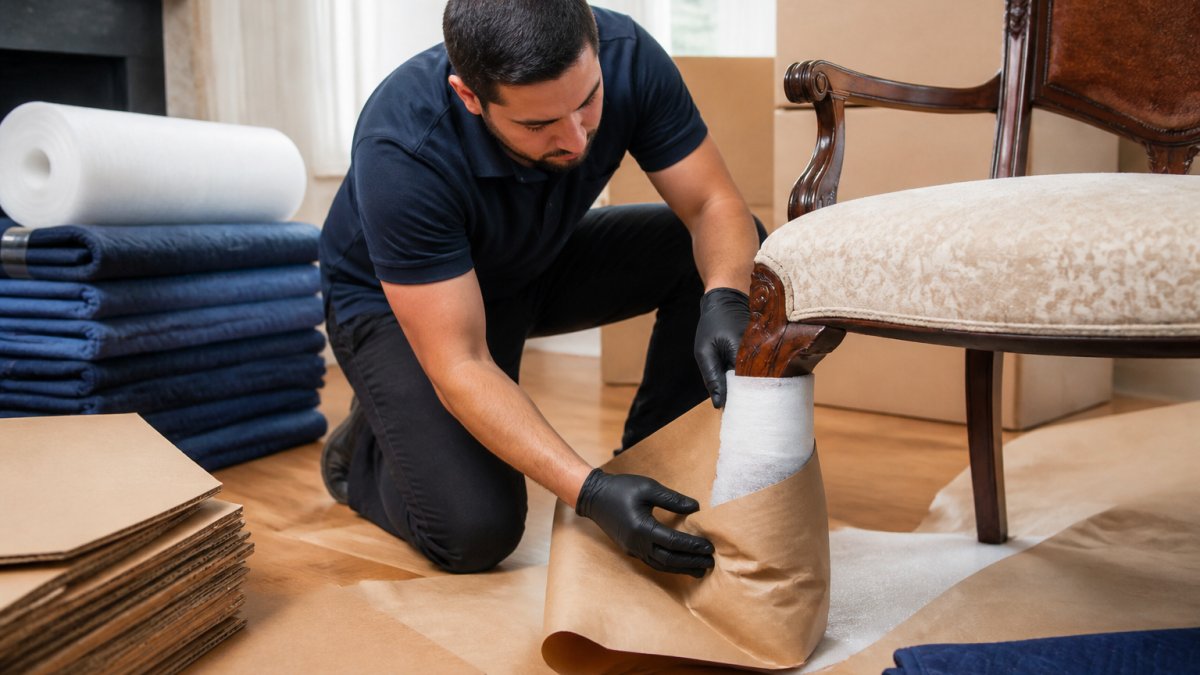
Moving blankets are the first line of defense for large antique furniture, absorbing impact and stopping scratches on tabletops, dressers, and cabinet fronts.
- Best for: sofas, armoires, dining tables, headboards
- Pair with: plastic wrap to hold the blanket in place
- Reusable: yes, for years
2. Bubble Wrap
Bubble wrap cushions carved details, handles, and fragile trim that blankets can’t reach. Small bubbles work better than large ones because they conform to curves and moldings; wrap two to three layers around protruding parts. The catch: bubble wrap can leave marks on some finishes if left in direct contact for months, so use packing paper as a barrier between the bubbles and bare wood.
- Best for: carved legs, finials, drawer pulls, glass inserts
- Avoid: direct contact with shellac or gilded surfaces for long storage
- Reusable: often, if the bubbles stay intact
3. Packing Paper
Packing paper is the safe direct-contact wrap for antique surfaces, and it’s acid-free in the better grades, which matters for long-term storage. Crumple it to fill empty spaces inside drawers and around joints. It’s soft, cheap, and forgiving: it won’t scratch and won’t react with old finishes.
- Best for: first layer on bare wood, wrapping small parts
- Also use for: filling gaps in boxes and drawers
- Reusable: no, but inexpensive
4. Foam Sheets and Foam Rubber
Foam sheets and foam rubber protect corners and edges, the spots that take the hardest hits. Cut them to size and tape them over each corner before wrapping the whole piece; thin foam also sits between stacked items and under glass panels. Use soft foam for delicate trim and firmer foam for heavy corners.
- Best for: corner protection, edge padding, glass and mirror backing
- Pair with: cardboard sheets for rigid backing
- Reusable: yes
5. Cardboard Boxes and Cardboard Sheets
Cardboard boxes and sheets give structure. Sturdy double-wall cardboard holds small antiques, hardware, and detached parts, while cardboard sheets slide behind glass, over tabletops, and between stacked furniture to stop punctures. Double-wall and triple-wall resist crushing better than single-wall, which is what you want under anything heavy.
- Best for: boxed parts, glass, flat panels, stacking separators
- Choose: double-wall or triple-wall for heavy or fragile loads
- Reusable: yes, if kept dry
6. Plastic Wrap
Plastic wrap holds blankets, paper, and foam in place and keeps dust and moisture off upholstery. Stretch it snug, but never directly against bare antique wood, since plastic can trap moisture and stick to some finishes over time. Treat it as the outer seal, not the inner layer.
- Best for: securing covers, protecting upholstery, weatherproofing
- Never: direct contact with bare wood or gilding
- Reusable: no
7. Packing Tape
Packing tape seals boxes and secures wraps, on the outside of the wrapping only. A good tape holds under weight and doesn’t peel in transit.
- Best for: sealing boxes, closing wraps, labeling
- Never: touching bare antique surfaces
- Reusable: no
What Else Belongs in Your Kit
Two more materials round out a serious antique packing kit: corner protectors and wooden pallets or crates for the heaviest pieces. Corner protectors are pre-formed caps that lock onto furniture corners, adding a rigid shell where impact is most likely.
- Corner protectors: rigid impact shield for each corner
- Wooden pallets: keeps furniture off damp floors
- Custom crates: for oversized, fragile, or high-value antiques
If you’d rather not source all of this yourself, our team at WePackYou brings professional-grade materials and custom-built wooden crating.
How to Pack Antique Furniture for Moving
Packing antique furniture for moving comes down to layers in the right order, and the order changes depending on what the piece is made of. Skip a layer and the finish is exposed; add them in sequence and the surface stays untouched.
The universal layer order (inside to outside):
- Clean and dry the piece completely. Dust under a wrap becomes an abrasive that grinds into a finish in transit.
- Remove drawers, hardware, shelves, and detached parts. Bag screws and escutcheons in a labeled zip-top bag and tape the bag to the piece, not to a box that can be separated.
- Wrap bare wood, gilding, and inlay in acid-free packing paper first. This is the barrier layer. Nothing plastic should touch the finish.
- Add foam to corners and edges. Corners take the hardest hits and are the most expensive to repair.
- Cushion carved details, finials, and applied molding with small-bubble bubble wrap over the paper.
- Cover large flat surfaces with a moving blanket.
- Secure everything with stretch plastic wrap on the outside only, never against bare wood.
- Slide cardboard sheets between stacked items and behind glass.
- Box small parts in double-wall cardboard and seal with packing tape on the box, not the furniture.
- Label every box and crate by room and contents.
That sequence works for a generic dresser. Antiques are not generic, so here is how the method changes by furniture type.
Cabinets, Chests, and Case Goods
Remove every drawer and pack each one separately so its weight does not stress the case during lifting. Pad the drawer runners and the inside of the carcass with packing paper, then close the doors and secure them with a strip of stretch wrap around the whole case, not tape on the door faces.
Tables
Remove the legs if they detach, and wrap each one individually in paper and foam. If they don’t, pad the apron and the underside of the top, then blanket the whole table. Marble and stone tops should come off and travel vertically in their own padded crate or box, never stacked flat under other weight.
Chairs
Chairs are the most-repaired antique in transit because the legs and stretchers take side loads. Wrap each leg in paper and foam, pad the back splat and any caning or rush seat with paper (never plastic directly on cane, which can soften and mold), and blanket the whole chair. Stack chairs back-to-back with a blanket or foam sheet between each one, never seat-to-seat.
Mirrors and Glass
Gilded and carved frames are the fragile part, not the glass. Tape an X of painter’s tape across the glass to hold shards in place if it breaks, then wrap the frame in paper, pad the corners with foam, and face the mirror against a rigid cardboard sheet or into a custom crate.
Upholstered Pieces
Fabric is vulnerable to dirt, snags, and moisture, not impact. Wrap upholstery in stretch plastic or a breathable furniture cover, then blanket the piece. Never seal an upholstered antique in plastic for long-term storage, because trapped moisture feeds mildew in the batting and frame.
Furniture With Removable or Fragile Components
Marble tops, glass shelves, mirrors, brass hardware, and inlaid panels should all be removed and packed independently, labeled, and kept with their piece. A detached marble top in its own box is far safer than one left on the console.
Layer order is paper first, foam at corners, bubble wrap over paper on details, blanket over the whole piece, and plastic wrap on the outside only. Then adjust the method to the furniture type, because a chair, a mirror, and a marble-topped console fail in three different ways.
How to Protect Antique Furniture During a Move
Protecting antique furniture during a move means controlling three risks: impact, moisture, and contact damage. Most guides cover impact and stop there, but for antiques, moisture and contact damage are what actually ruin pieces, and both come from the materials you choose, not the movers.
Contact Damage: What Should Never Touch an Antique Surface
Antique finishes are not modern catalyzed coatings. Shellac, lacquer, varnish, and gilding are softer, more porous, and more reactive than new-furniture finishes, and some common packing materials bond to them or leave marks.
- Standard masking, duct, and packing tape: the adhesive bonds to shellac and lacquer and can pull the finish off in patches on removal. Tape goes on the wrapping, never on the piece.
- Stretch plastic wrap in direct contact: plasticizers in some films can transfer marks to a finish, and the wrap can trap moisture against the wood. Use it as the outer seal only.
- Bubble wrap in long direct contact: most practitioners find that bubble wrap left against a finish for months can leave a faint pattern or trap condensation. Paper goes between the bubbles and the wood.
Safe barrier layers to use instead: acid-free packing paper, unbleached tissue, and clean cotton or muslin sheeting. These are the materials that can touch a bare antique surface without reacting with it.
Moisture, Humidity, and Condensation
Wood moves with humidity. An antique acclimated to a dry, climate-controlled room can crack, warp, or lift veneer in a humid truck or damp storage unit, and packing materials either slow that exchange or accelerate it.
- Plastic traps moisture. Sealing a piece in stretch wrap or a plastic bag for long-term storage holds ambient moisture against the wood and can cloud a finish or feed mildew in upholstery and cane.
- Ventilation matters more than sealing. For storage longer than a few weeks, leave a small gap in the outer wrap so the wood can breathe, and store in a climate-controlled space rather than a garage or unconditioned unit.
- Keep pieces off bare floors. Concrete and damp floors wick moisture into legs and feet. Set pieces on wooden pallets or furniture pads.
Impact and Stacking
- Never stack heavy items on antique furniture. Stacking pressure cracks veneer, crushes cane, and bows tabletops.
- Keep the heaviest pieces low and the lightest on top, and never lay a mirror or glass flat under weight.
- Pad every corner, because corners take the first hit and are the most expensive repair.
Long-Term Storage Checklist
- Climate-controlled space, not a garage, attic, or unconditioned unit
- Pieces on pallets or pads, off bare floors
- Outer wrap vented, not sealed airtight
Sealing an antique in plastic for months is one of the most common ways a finish gets clouded or a frame gets moldy. Plastic is an outer weather layer for transit, not a storage wrap. For long-term holds, paper and blankets breathe; plastic does not.
If a piece has been in a cold truck or a cold storage unit, let it come to room temperature before you unwrap it. Unwrapping a cold piece in a warm, humid room can condense moisture right onto the finish.
Custom Crating for Antique Furniture
Custom crating for antique furniture is the strongest protection available for oversized or high-value pieces. A crate is built to the exact dimensions of the piece, with foam blocking and bracing inside so nothing shifts, and it also protects against stacking pressure and rough handling that blankets alone can’t absorb.
Frequently Asked Questions
What are the 10 best materials for packing antique furniture?
The 10 materials are moving blankets, bubble wrap, packing paper, foam sheets, double-wall cardboard boxes and sheets, plastic wrap, packing tape, corner protectors, plastic moving boxes, and wooden pallets. Each one plays a specific role: blankets cushion large surfaces, paper wraps finishes, foam absorbs impact, cardboard adds structure, and tape seals everything. For antique furniture, layer these materials so nothing abrasive touches the wood directly.
What materials should you avoid using directly on antique wood?
Avoid direct contact between antique wood and standard plastic wrap, packing tape adhesive, and newspaper. Plastic wrap traps moisture against the finish and can leave cloudy marks. Tape adhesive can pull up shellac or lacquer. Newspaper ink transfers onto porous wood and veneer. Always place packing paper or foam sheets as a barrier layer between the wood and any plastic or tape.
Should antique furniture be wrapped in plastic?
Plastic wrap should never touch the finish directly. Use it only as an outer layer over moving blankets or foam to hold coverings in place and block dirt and moisture during transit. For long-term storage, skip plastic entirely and use breathable materials like moving paper and cotton blankets, because sealed plastic can trap humidity and encourage mold on antique wood.
How do you protect antique furniture from scratches during a move?
Wrap every surface in packing paper first, then add a layer of moving blankets or foam sheets. Slide corner protectors onto edges and legs. Use plastic wrap only over the padding, never against the wood. Keep hardware, keys, and removable parts in labeled bags taped to the piece, and never stack items on top of an antique during loading or transit.