Table of Contents
- What Professional Packing Services for Seniors Downsizing Include
- How to Downsize Before a Move: A Step-by-Step Approach
- Your Senior Move Planning Checklist for a Smooth Transition
- Packing Fragile Items for Long Distance: Protecting What Matters Most
- Packing and Organizing Services for Seniors: What to Look For
- What Professional Packing Services for Seniors Downsizing Cost
- Conclusion
- Frequently Asked Questions
Last Updated: October 7, 2026
What Professional Packing Services for Seniors Downsizing Include
Professional packing services for seniors downsizing handle the physical work of sorting, wrapping, boxing, and labeling a lifetime of belongings so the move itself stops being the hardest part. At WePackYou, we treat that as a care job first and a logistics job second.
The goal is a secure transition, not a fast one. Patience is the operating principle.
Packing, Unpacking, and Organizing Options
For a downsizing move, the middle option usually fits best. Seniors often need help deciding what travels and help settling it back into a smaller space. Unpacking is where the new home starts to feel like home.
Ask for a labeled floor plan before packing day. When boxes are numbered by room and marked “kitchen, open first,” the first night in a new place stops feeling chaotic.
How to Downsize Before a Move: A Step-by-Step Approach
Downsizing works best when it starts weeks before the first box, not the day the truck arrives. Work one room at a time, and never attempt the whole house in a weekend.
- Pick a starting room with the least emotional weight, like a guest room or garage.
- Set a weekly target. One closet or one cabinet per session is realistic.
- Measure the new space. Note closet depth, kitchen storage, and any stairs.
- Sort into four piles: keep, donate, sell, discard.
- Photograph sentimental items you cannot take, then pass them on.
- Book the packers once the keep pile is roughly defined.
The order matters. Sorting before packing means movers only handle what is actually moving, which lowers cost and shortens moving day.
Deciding What to Keep, Donate, Sell, or Discard
The keep pile should be built around use, not memory. A practical rule: if an item has not been used or displayed in two years, it belongs in one of the other three piles.
| Category | Best For | What To Do With It |
|---|---|---|
| Keep | Daily-use furniture, documents, medications, keepsakes | Pack and label by room |
| Donate | Clothing, kitchenware, books, working appliances | Schedule a pickup or drop-off |
| Sell | Antiques, tools, collectibles, quality furniture | Consignment, estate sale, or online listing |
| Discard | Broken items, expired goods, worn textiles | Arrange bulk trash pickup |
What most guides miss is the fifth pile: decide later. Give yourself one small box for genuinely undecidable items and revisit it after the move. Forcing a decision on everything at once is what exhausts people.
Your Senior Move Planning Checklist for a Smooth Transition
A senior move planning checklist keeps the emotional and physical load manageable by spreading tasks across weeks. Start eight weeks out for a house, four weeks for an apartment.
- Confirm the move date and building access rules
- Measure doorways, elevators, and stairwells
- Notify doctors, pharmacy, insurance, and utilities
- Forward mail and update your address
- Book packing services and confirm insurance coverage
- Arrange a donation pickup for the week before the move
- Pack a first-night box: medications, bedding, toiletries, chargers
- Confirm parking or loading permits for moving day
Family and caregiver coordination belongs on this list too. Assign one person to be the point of contact so the senior is not fielding every question.
A Practical Packing Timeline for Seniors
The timeline below assumes professional packers handle the heavy lifting. Adjust it if you are packing yourself.
| Timeframe | Task |
|---|---|
| 8 weeks out | Declutter, measure, book packers |
| 6 weeks out | Sort keep/donate/sell/discard room by room |
| 4 weeks out | Schedule donation and junk removal pickups |
| 2 weeks out | Pack off-season items and decor |
| 1 week out | Confirm move logistics and insurance |
| Moving day | Packers handle the rest; you direct placement |
Do not leave medication, financial documents, jewelry, or keys to the packers. Keep those with you in a personal bag. Items that travel in your own car are the ones you cannot replace.
Packing Fragile Items for Long Distance: Protecting What Matters Most
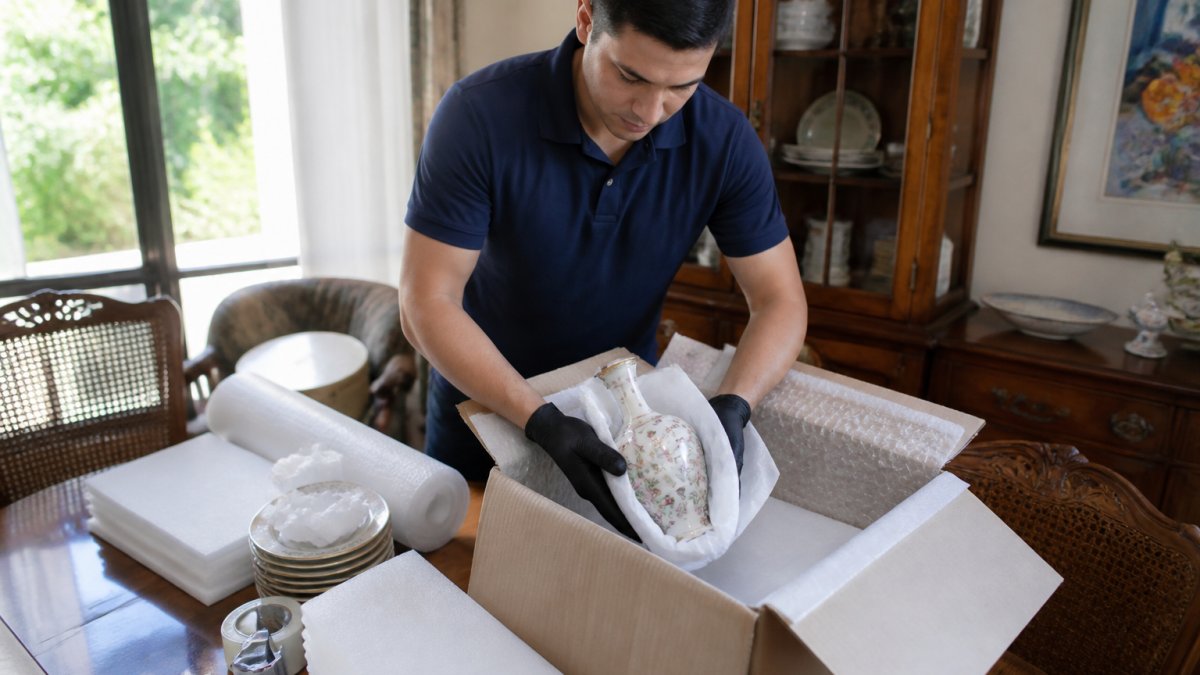
Packing fragile items for long distance requires more cushioning and better bracing than a local move, because boxes ride through hours of vibration.
The Box-Within-a-Box Method
For anything breakable, the standard technique is a box inside a box:
- Wrap the item individually in tissue or bubble wrap, then tape the wrap so it does not shift.
- Line a small box with foam or crumpled paper on all six sides.
- Place the wrapped item so it cannot touch the box walls.
- Seal the small box, then place it inside a larger box with at least two inches of cushioning on every side.
- Label the outer box “FRAGILE” on the top and two sides, and mark which way is up.
For high-value pieces, custom-built wooden crating is the safer route. A crate holds its shape under stacking pressure, which a cardboard box cannot do.
Protecting Heirlooms, Medications, and Documents
This is where a senior move differs from a standard move, and where most guides stop short. Some items should never go in the moving truck at all:
- Medications: Keep a full supply in a personal bag, not a packed box. A move can stretch across a day or more, and a missed dose is a health risk, not an inconvenience.
- Financial and legal documents: Wills, deeds, powers of attorney, insurance policies, and passports belong with you. If a box is delayed or lost, these are the hardest to replace.
- Jewelry and small valuables: Carry them personally. Do not leave them for the packers, even with a written inventory.
- Keys and access items: Car keys, house keys, mailbox keys, and building fobs stay on your person.
For heirlooms that do travel, photograph each item before packing and note it on a written inventory. A chipped teacup from a grandmother’s set is not replaceable at any price, but a photo and a record help with an insurance claim if the worst happens.
Labeling and Inventory That Survive the Move
Label every fragile box on the top and two sides, and keep a written inventory. If something does arrive damaged, that list is what an insurance claim is built on. Number each box and match it to the inventory sheet, so a missing box is obvious the moment unloading starts.
Seniors moving long distance with antiques, artwork, or heirloom china that would be impossible to replace.
Treat medications, documents, jewelry, and keys as carry-with-you items, never as packed items. Everything else can be replaced; those four cannot.
Packing and Organizing Services for Seniors: What to Look For
The right provider specializes in packing rather than treating it as an add-on to moving. Specialists bring better materials, faster hands, and fewer broken items.
Look for these markers:
- Trained packing specialists, not general labor
- Professional-grade materials: double-wall boxes, foam, crating
- Written insurance coverage for the packing work itself
- Experience with seniors, including patience and flexible pacing
- A written estimate that itemizes packing separately from transport
Ask directly how they handle a fragile item and who pays if it breaks. A confident, specific answer is a good sign.
Credentials, Insurance, and Vetting Professional Packers
Vetting professional packers comes down to three checks: licensing and registration, insurance, and references. Ask for a certificate of insurance and confirm what it covers, because packing coverage and moving coverage are often separate policies.
Then read reviews for patterns, not star ratings. A single complaint about a late arrival means little. Repeated notes about rushed packing or damaged boxes mean a lot.
Insurance is the line between a stressful move and a financial loss. Get the coverage details in writing before packing day, and confirm whether the policy covers packing, transit, or both.
What Professional Packing Services for Seniors Downsizing Cost
Pricing for professional packing services for seniors downsizing depends on home size, how much is being packed, how much sorting help you need, and how far the move runs. There is no single flat rate, and any quote given over the phone without a walkthrough is a guess.
What Actually Drives the Price Up or Down
Packing costs are not random. They move with a predictable set of factors:
| Factor | Effect on Cost |
|---|---|
| Fragile items (china, glass, art) | Higher, more materials and slower hands |
| Custom wooden crating | Higher, built to order, not off the shelf |
| Stairs, long carries, elevator reservations | Higher, more labor hours per box |
| Already decluttered before packing day | Lower, packers only touch what is moving |
| Off-season packing done in advance | Lower, spreads labor across visits |
| Full unpacking at destination | Higher, adds a second on-site phase |
Questions to Ask Before You Sign
A written, itemized estimate is the only number worth trusting. Ask these before you commit:
- Is packing priced separately from transport, or bundled?
- Does the estimate include materials (boxes, tape, foam, crating), or are those billed on top?
- What happens if the job runs past the quoted hours?
- Is there a minimum crew size or minimum charge?
- Are stairs, long carries, or elevator reservations surcharges?
- Who pays if a packed item arrives damaged, and what is the claims process?
Be cautious with any estimate that arrives before someone has seen the home. Packing scope is impossible to judge from a phone call, and vague quotes are where surprise charges come from.
The honest answer to “what will this cost” is: get a written, itemized estimate after an on-site walkthrough. WePackYou provides free quotes.
How to Compare Two Estimates Fairly
Two quotes can look identical on the bottom line and cover completely different work. Put them side by side on these points:
- Scope: Does each quote include sorting help, or only packing the keep pile?
- Materials: Are boxes, tape, bubble wrap, and crating included or billed separately?
- Insurance: Is packing coverage included, or is it a separate policy?
- Timeline: How many visits, and how many crew members per visit?
The lowest number is rarely the lowest total cost once materials, surcharges, and unpacking are added back in.
Conclusion
Downsizing asks a senior to sort through decades of belongings while managing the physical strain of packing and the emotional weight of letting go. That is a lot to carry alone, and it is exactly the work a packing team should absorb. WePackYou sends trained specialists who pack with care, build custom crates for fragile and oversized pieces, work around your schedule including evenings and weekends, and carry full insurance on every job. Get a free quote from WePackYou and let our team handle the boxes while you focus on the next chapter.
Frequently Asked Questions
What do professional packing services for seniors include?
Professional packing services for seniors typically cover sorting and organizing belongings, wrapping fragile and sentimental items, providing packing supplies, labeling boxes by room, and loading items for transport. Some providers also offer unpacking and home setup. WePackYou specializes exclusively in packing, with trained specialists who use professional-grade materials and custom crating for oversized or fragile pieces. Services can be tailored to your timeline and schedule, including evenings and weekends.
How do you help a senior downsize before a move?
Downsizing help starts with a room-by-room assessment to decide what to keep, donate, sell, or discard. Professional packers can assist with sorting, then pack only the items moving to the new home. A senior move planning checklist keeps the process organized, and a practical packing timeline spreads the work over several weeks. For seniors feeling overwhelmed, compassionate packers work at a comfortable pace and coordinate with family members to make decisions easier.
How much do professional packing services cost?
Packing costs depend on the size of your home, the volume of items, the complexity of packing fragile or oversized pieces, and your timeline. Some providers publish hourly rates or minimums, but many offer custom quotes after an in-home assessment. WePackYou does not list fixed prices because every job is different. For current rates and a free quote, contact WePackYou directly through their website. Always confirm what is included, such as supplies, insurance, and unpacking.
How should families decide what a senior keeps when downsizing?
Start by measuring the new space and identifying furniture that fits. Then sort belongings into four categories: keep, donate, sell, or discard. Sentimental items deserve special attention; if a senior wants to keep them, professional packers can wrap and protect them for transport. Family members can help by taking photos of items that are hard to part with, or by storing a few boxes. Involving the senior in decisions preserves dignity and reduces stress.