Table of Contents
- Why Antique Furniture Needs More Than Blankets and Boxes
- Benefits of Professional Crating for Antique Furniture: Protection That Goes Beyond Padding
- How to Ship Antique Furniture: Assessing Size, Weight, and Fragility
- Custom Crating for Antique Furniture: When Off-the-Shelf Won’t Work
- Antique Furniture Shipping Cost: What Drives the Price
- Shipping Insurance for Antiques: Documentation, Valuation, and Claims
- Professional Crating vs. DIY Crating vs. Blanket Wrapping
- Conclusion: Protecting What Can’t Be Replaced
- Frequently Asked Questions
Last Updated: October 12, 2026
Why Antique Furniture Needs More Than Blankets and Boxes
Antique furniture is irreplaceable, which changes how it should be moved. A scratch on a mid-century sideboard is an annoyance; a split leg on a family heirloom is a permanent loss.
Blanket wrapping has its place for short, local moves. The Smithsonian’s guidance on packing and transporting museum objects makes the same point for collections: padding alone rarely survives a multi-stage journey intact.
What Standard Packing Misses
Cardboard boxes and moving blankets cushion an item against a single impact. They do nothing about the forces that build up over a cross-country haul.
A wrapped chair still rests on its own legs, so every bump travels straight up through the frame.
Standard packing also leaves gaps. When a piece shifts inside a loose box, it abrades against whatever it touches, the source of most scratches and dents, not dramatic drops.
The most common mistake we see is wrapping a piece tightly in plastic before a long move. Plastic traps moisture against the finish, and a humid trailer turns that into cloudiness, lifting veneer, or mold. Use breathable materials for anything that will sit wrapped for more than a day or two.
The Real Cost of Transit Damage
Damage rarely destroys a piece outright. It erodes value.
A repaired leg joint, touched-up corner, or refinished top all show up in an appraisal, meaning a meaningful drop in what a buyer will pay.
There is also the time cost. Sourcing a restorer, filing a claim, and waiting on repairs can stretch for months. Professional crating exists to prevent that entire chain of events.
Benefits of Professional Crating for Antique Furniture: Protection That Goes Beyond Padding
The benefits of professional crating for antique furniture come down to three things: even support, separation from the crate walls, and control of the environment inside the crate.
A well-built crate holds the piece so it cannot move, supports it so its own weight does not stress the frame, and buffers it from moisture and vibration.
Even Support and Wall Separation
A custom crate supports an antique along its strongest structural points. Blocking and bracing are shaped to the piece, so the load spreads across the frame instead of concentrating on one leg or corner.
Just as important is what does not touch. As conservation guidance from the National Park Service notes, direct contact between an object and its container is one of the leading causes of transit damage.
Climate, Moisture, and Vibration Control
Wood moves with humidity. A crate that sits in a hot truck by day and a cold warehouse by night exposes an antique to constant swelling and shrinking, how veneer lifts and joints loosen over a long haul.
Crating gives you a sealed, buffered space: desiccant controls moisture, the crate slows temperature swings, and the wooden structure dampens road vibration, the quiet culprit behind hairline cracks in old finishes.
Ask whether the crate will be lined with a moisture barrier and whether desiccant packs are included. On a long-distance move, that detail matters more than the thickness of the crate walls. It is also the first thing many providers leave out to hit a lower quote.
How to Ship Antique Furniture: Assessing Size, Weight, and Fragility
Shipping antique furniture starts with an honest assessment of dimensions, weight, fragility, and value. Those factors decide whether you need a crate, how it should be built, and what it will cost.
Here is how we would walk through it:
- Measure the piece at its widest points, including any protruding arms, feet, or finials.
- Weigh it, or estimate from the material and size. Solid oak and marble tops change everything.
- Identify weak points. Loose joints, thin legs, veneer edges, and glass inserts are the fragile zones.
- Note the value. This drives both the crate spec and your insurance coverage.
- Check the route. Tight hallways, stairwells, and doorways affect how the piece is packed and loaded.
A heavy, unusually shaped, high-value piece almost always justifies a crate; a sturdy, low-value item on a short local move may not.
| Factor | Low Risk | High Risk |
|---|---|---|
| Distance | Local, single handling | Long-distance, multiple transfers |
| Weight | Light, easy to lift | Heavy, requires equipment |
| Shape | Rectangular, compact | Unusually shaped, protruding parts |
| Condition | Solid joinery | Loose joints, fragile veneer |
| Value | Replaceable | Irreplaceable or high-value |
Custom Crating for Antique Furniture: When Off-the-Shelf Won’t Work
Custom crating for antique furniture is the right call when a piece is oversized, unusually shaped, heavy, or fragile enough that a standard container cannot hold it safely.
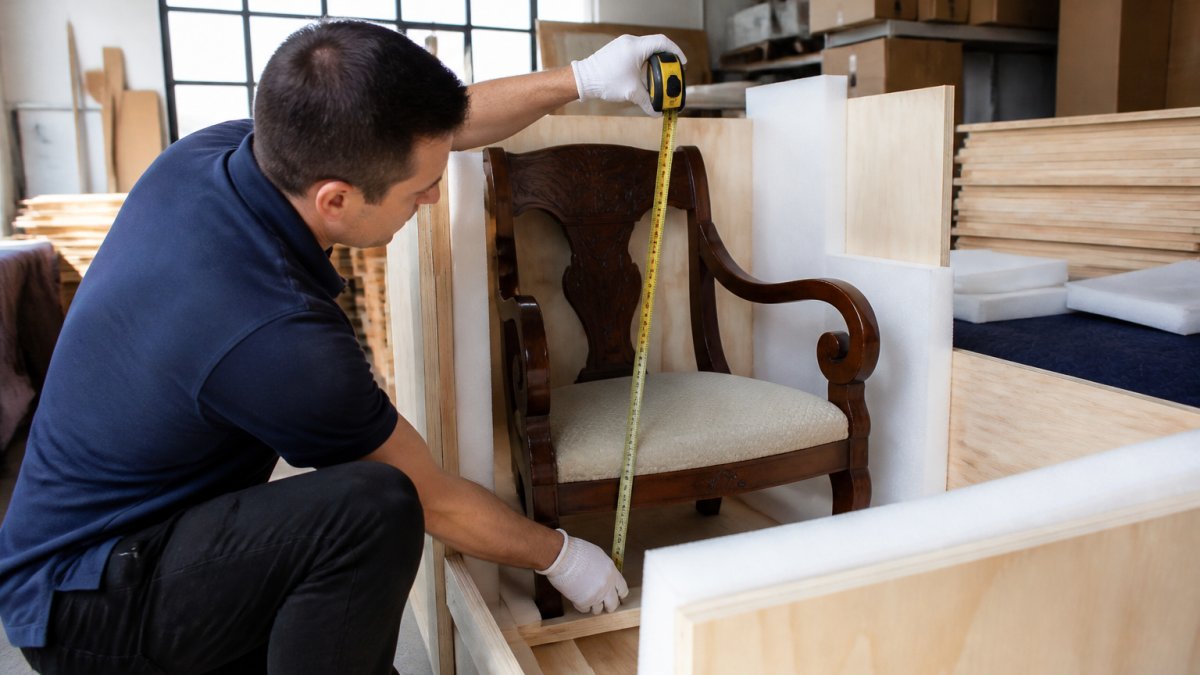
A serpentine-front chest, curved settee, or clock with a fragile finial all need a crate built around them, designed to the piece, not the other way around.
How Professionals Build a Custom Crate
The process follows a consistent sequence, whether the piece is a side table or a grand piano:
- Assess and document. Photograph the piece from every angle and note existing wear before anything is touched.
- Wrap the item. Soft, conservation-safe materials go against the surface first, never plastic directly on the finish.
- Build the base. A sturdy wooden base is sized to the piece and reinforced to carry its weight.
- Block and brace. Custom-cut supports hold the item in place and lift it off the crate floor.
- Add cushioning. Foam and padding fill the gap between the item and the crate walls.
- Close the crate. Walls, lid, and base are fastened with the item fully immobilized inside.
- Label and seal. Mark the crate with handling instructions and seal it for transit.
Expected result: a piece that cannot shift, cannot contact the crate walls, and arrives in the condition it left in.
Antique Furniture Shipping Cost: What Drives the Price
Antique furniture shipping cost depends on size, weight, distance, crate complexity, and insurance. What most quotes hide is how the number is built. Once you understand the mechanics, you can compare bids on equal footing instead of guessing which one is padded.
The Four Cost Buckets
Every professional crating quote is a stack of four buckets. Ask a provider to break it down this way and the differences between bids become obvious.
- Materials. Plywood or solid lumber for the crate shell, dimensional lumber for blocking and bracing, foam and padding, moisture barrier film, desiccant, fasteners, and labels. A simple rectangular crate for a side table uses a fraction of the material of a crate built around a serpentine-front chest or a piece with a fragile finial.
- Labor hours. Measuring, photographing, wrapping, building the base, cutting blocking, cushioning, closing, and labeling. A straightforward piece can be crated in a few hours. A curved settee, a clock with delicate works, or a piece that requires partial disassembly can take a full day or more.
- Crate class. A one-way crate (built to be discarded at destination) costs less than a reusable crate with hinged access panels, lifting handles, and a bolted lid. Reusable crates are common for pieces that will travel again, such as a collection that moves between residences.
- Accessorials. Stairs, tight doorways, elevator reservations, long carries, after-hours scheduling, and lift-gate requirements all add labor. These are the line items most often left off an initial quote and added later.
Why Two Quotes for the Same Piece Can Differ by Hundreds
Two providers can measure the same piece and return quotes that look nothing alike. The gap usually comes from four places:
- Crate wall thickness and bracing density. A crate built with thinner panels and fewer braces will quote lower and protect less. Ask what thickness is specified and how many braces support the piece.
- Cushioning material. Foam density and thickness vary widely. Conservation-safe, low-abrasion materials cost more than general-purpose foam.
- Moisture control. A lined crate with desiccant is a different product than a bare wooden box. On a long-distance move, this is the difference that matters most.
What a Quote Should Include
A written estimate should state, at minimum:
- Crate dimensions and wall thickness
- Blocking and bracing approach
- Cushioning materials and moisture-control method
A single number with no breakdown is a placeholder, not a price.
Reported Ranges as a Sanity Check
Reported custom-crating costs for antiques and fine furniture have ranged from roughly $250 to $1,200 per piece, according to Safebound Moving & Storage’s 2026 guide to custom crating and climate risk. International shipments run far higher, with reported costs of $3,500 to $8,000 depending on size, weight, and destination, per AB Group Shipping’s guide to moving antiques internationally.
Ask each provider to quote the same crate specification. If one bid is dramatically lower, ask which material, brace, or moisture-control element was removed to get there. The answer tells you what you are giving up.
For WePackYou’s own packing and crating services, pricing depends on the piece, the distance, and the timeline. Request a quote for an accurate figure rather than relying on a generic estimate.
Shipping Insurance for Antiques: Documentation, Valuation, and Claims
Shipping insurance for antiques only pays out if you can prove what you shipped and what it was worth. Documentation is the difference between a claim that gets paid and one that gets denied, so the harder questions are how value is established, what the policy excludes, and what happens after damage occurs.
How Value Is Established
Carriers and insurers do not accept a purchase price or family estimate at face value. They want a defensible number, and there are three common ways to get one:
- Replacement value. What it would cost to buy a comparable piece in today’s market. This is the most common basis for household-goods and moving policies.
- Fair market value. What the piece would sell for between a willing buyer and seller. Common for collectible and estate pieces.
- Appraised value. A written appraisal from a qualified appraiser, typically required above a threshold the carrier sets. Appraisals should be dated and describe the piece, its condition, provenance, and the basis of value.
For high-value pieces, get the appraisal before the move, not after. An adjuster who receives an appraisal dated after the loss will scrutinize it far more closely.
Common Exclusions to Read Before You Sign
Policies vary, but the same exclusions appear again and again. Read the exclusions page, not just the coverage summary.
- Pre-existing damage. Anything visible in your pre-move photos is excluded. This is why dated condition photos matter more than any other document.
- Inherent vice. Damage caused by the piece’s own condition, such as a joint that was already failing, is often excluded.
- Improper packing. If the carrier determines the piece was not packed to its standard, the claim can be denied. A professional crate spec is your defense here.
The Claims Process, Step by Step
If damage occurs, the sequence matters. Moving quickly and documenting thoroughly improves the outcome.
- Inspect before you sign. Note any visible crate damage on the delivery receipt before the driver leaves. Signing a clean receipt can limit your claim.
- Photograph the crate and the piece before unpacking, then again as you unpack. Capture the damage from multiple angles and in good light.
- Stop unpacking if damage is significant. Further handling can worsen it and complicate the claim.
- Notify the carrier and insurer in writing within the window stated in your policy. Many policies require notice within a set number of days.
- Submit the documentation package: pre-move condition report with dated photos, appraisal or valuation, inventory, bill of lading, crate specification, and post-delivery photos.
- Get a repair estimate from a qualified restorer. The estimate supports the dollar figure in the claim.
- Keep the damaged piece and the crate until the claim is resolved. Discarding either can weaken your position.
Documentation Checklist
Before the piece leaves, gather:
- Photos of every side, plus close-ups of any existing damage, with a date reference.
- A valuation or appraisal for high-value pieces. An insurance adjuster will ask for it.
- A written inventory describing the piece, its condition, and its dimensions.
The single most important step for any high-value antique is a pre-move condition report with dated photos. Without it, a carrier can argue the damage existed before the move, and you have no way to prove otherwise. The second most important step is reading the exclusions page before you sign, not after you file.
Professional Crating vs. DIY Crating vs. Blanket Wrapping
The right choice depends on the piece, the distance, and the risk you are willing to carry.
| Method | Best For | Protection Level | Main Risk |
|---|---|---|---|
| Blanket wrapping | Short local moves, sturdy items | Low | Scratches, shifting, no moisture control |
| DIY crating | Low-value, simple shapes, tight budget | Medium | Poor fit, weak structure, no climate control |
| Professional crating | High-value, fragile, oversized, long-distance | High | Higher upfront cost |
Blanket wrapping is fast and cheap, and for a sturdy piece moving across town it can be enough.
Where DIY crating usually fails is the fit: a crate slightly too large lets the piece shift, one slightly too small puts pressure on the frame.
Collectors and families moving high-value, fragile, or oversized antiques over long distances, where the cost of a crate is far less than the cost of damage.
Conclusion: Protecting What Can’t Be Replaced
Every antique that survives a move intact does so because someone planned for the forces working against it. Padding handles impact.
At WePackYou, we build custom wooden crates for oversized and fragile pieces, use professional-grade packing materials, and provide fully insured packing jobs.
Get started with WePackYou and move your antiques with the protection they deserve. Request a free quote today.
Frequently Asked Questions
What are the benefits of professional crating for antique furniture?
Professional crating protects antique furniture from impact, pressure, moisture, and temperature changes during transit. Custom crates keep the item from touching crate walls and provide even support, which helps prevent scratches, dents, and structural damage. Crating also makes handling and loading safer for heavy or unusually shaped pieces, and it supports insurance claims because the item was packed to a professional standard.
How much does it cost to crate antique furniture?
Crating costs depend on the piece’s dimensions, weight, fragility, and the distance it will travel. Request a quote based on your specific item rather than relying on averages.
Is professional crating safer than packing antique furniture yourself?
Professional crating is generally safer for high-value, fragile, or oversized antiques because trained specialists use conservation-safe materials, custom-fit designs, and proper cushioning techniques. DIY packing can work for small, sturdy items, but it often lacks the even support and wall separation that prevent damage during carrier handling. If your piece is delicate, heavy, or irreplaceable, professional crating reduces risk.
Does crating protect antique furniture from moisture and impact?
Yes. A well-built crate shields furniture from direct impact and helps buffer changes in humidity and temperature that can cause wood to crack or warp. Moisture barriers and ventilation gaps are sometimes built into the crate design. Crating also reduces the chance of scratches and dents from contact with other items during loading, transit, and unloading.